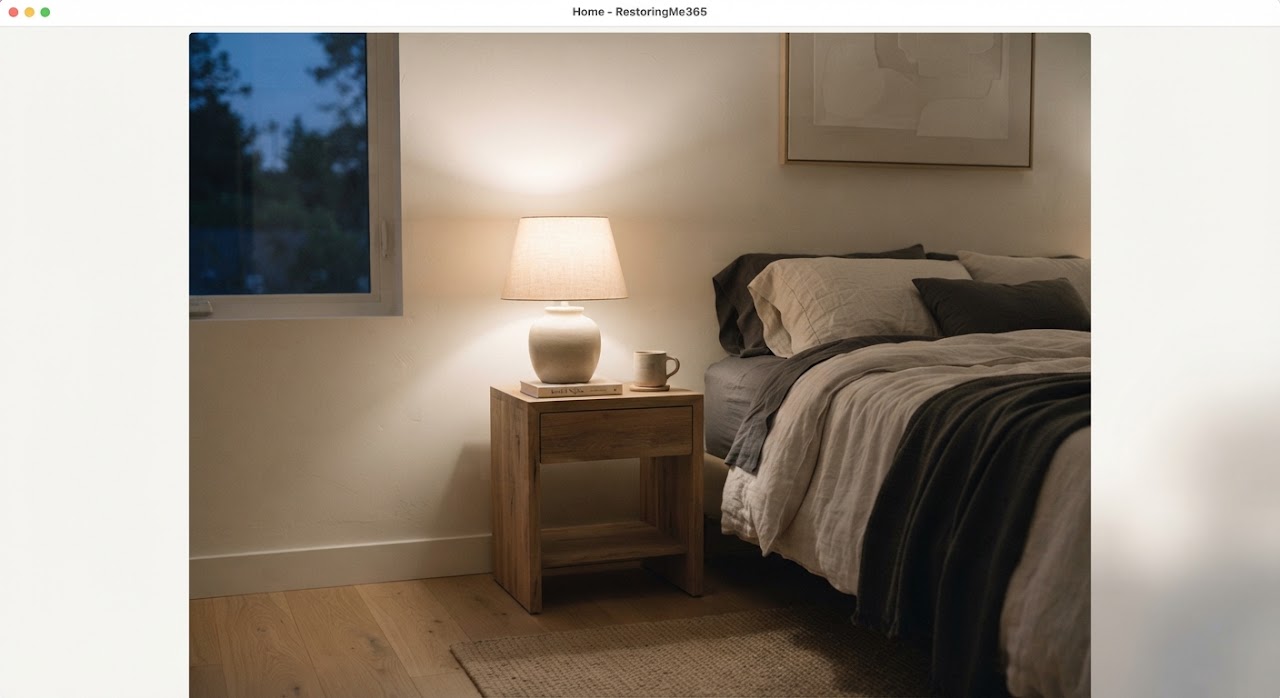
You can do everything right in the evening, wind down carefully, avoid late caffeine, keep steady hours, and still lie awake if the room itself is working against you. Your bedroom is not a neutral backdrop. It is an active participant in your sleep, sending constant signals about light, temperature, sound, and safety that your body reads all night long.
The encouraging part is that environments are far easier to change than habits. You do not need a renovation or a drawer full of expensive gadgets. A handful of deliberate adjustments can turn the room from a source of quiet interference into one of your strongest allies.
The signals your body is reading
Light is the loudest signal. Even modest evening light, from a streetlamp through thin curtains or a charging LED on the dresser, can suppress melatonin and shallow your sleep. Temperature comes next: your core temperature needs to drop for sleep to deepen, and a warm room resists that drop. Most people sleep best somewhere around sixteen to nineteen degrees Celsius, roughly sixty to sixty seven Fahrenheit, which is cooler than feels intuitive for a living space.
Sound matters even when it does not wake you fully. Traffic, a partner’s phone, a ticking radiator: these can pull you into lighter sleep stages without ever registering in memory. And then there is association. If the bed is where you work, scroll, argue, and worry, your brain gradually learns that lying down is a cue for alertness rather than rest.
Common saboteurs hiding in plain sight
Some culprits are obvious once named. The television facing the bed. The phone charging on the nightstand, close enough to reach without thinking. Others are subtler: a mattress a decade past its best, an ageing pillow that leaves your neck negotiating all night, or clutter that keeps the room feeling like an unfinished task. Even a busy wall colour or a pile of laundry plays a part, not magically, but through the low hum of stimulation it adds to a space meant for switching off.
A restful room asks nothing of you. That is what makes it restful.
Walk into your bedroom in daylight and look at it as a stranger might. Ask one question of each thing you see: does this help me sleep, or does it ask something of me? Anything in the second category is a candidate for removal, relocation, or repair. You are not aiming for a showroom. You are aiming for a room with fewer demands in it.
Fixes worth making first
You do not have to address everything at once. Start with the changes that offer the largest return for the least effort and expense.
- Darken it properly: fit blackout curtains or wear an eye mask, and cover or remove every glowing standby light, however small it seems.
- Cool it down: set the thermostat lower at night, choose breathable bedding, and open a window when the season allows.
- Soften the soundscape: try earplugs, a quiet fan, or steady white noise to blur the unpredictable sounds that fragment light sleep.
- Evict the screens: charge your phone outside the bedroom and let an ordinary alarm clock take over its one legitimate job.
Make one change this week and give it a few nights before adding the next, so you can notice what each adjustment actually does for you. Sleep environments work quietly, so the improvement may appear as mornings that feel slightly less heavy rather than one dramatic night. That is exactly how it should be. A good bedroom does not perform. It simply stops interfering, and lets your body do what it has always known how to do.